Executive Summary
In The Rise of Latino America, we argue that Latinos, who are projected to become America’s largest ethnic group, are a dynamic force shaping the nation’s demographic, economic, and cultural future. Far from being a marginalized group defined by oppression, Latinos are integral to America’s story. They drive economic growth, cultural evolution, and workforce vitality. Challenges, however, including poverty, educational disparities, and restrictive policies, threaten their upward mobility. Policymakers who wish to harness Latino potential to ensure national prosperity and resilience should adopt policies that prioritize affordability, safety, and economic opportunity over ideological constraints.
We urge policymakers to reject ideologically driven policies that hinder Latino progress, such as restrictive land use, costly climate mandates, and reduced personal mobility. Embracing policies that align with Latino aspirations rooted in work, family, and opportunity will not only empower this vital population but also strengthen America’s economic and demographic future in a competitive global landscape.
Introduction
Migration has shaped America’s history. The earliest migrants, the ancestors of the American Indians, arrived from far east Asia. Migration from the British Isles in the seventeenth and eighteenth centuries was voluntary but thousands of enslaved people also arrived here from Africa at the same time. The nineteenth and twentieth centuries saw waves of Germans, Italians, Russians, East Asians, Indians, and Jews.
Each group has faced sometimes brutal discrimination from the dominant majority. Many on the left see such racial prejudice as the American experience’s defining characteristic. From this perspective, Latinos are simply the latest group to live under an oppressive regime and whose lands “settlers” stole.
Yet the Latino experience is unique and far more uplifting. Latinos differ from Europeans: notably, they migrated to a country whose territory Anglo immigrants had conquered—in Texas initially and later across the entire Southwest—and taken from them.
But contrary to the narrative of “settler colonialism,” very few of today’s Latino residents can trace themselves to earlier settlers; the vast majority are recent arrivals. Indeed, the Southwest’s entire Mexican population in 1848 was barely 48,000. Yet the dominant academic and progressive narrative remains one of unending oppression and seizure of land. Latinos, writes one leftist writer, have “been forgotten by the nation” and have “nothing but their angers and their hungers.” Like the Anglos who settled areas seized from Mexico, they too want a piece of the pie, someplace safe and prosperous for their families to live and where they can acquire wealth.
At the same time there are some on the political right who fear America’s ongoing Latinization. Some influential right-wing theorists continue to hold the notion that Latinos are intrinsically inferior to whites and Asians. Others fear that the Latinos blend of Catholic and Indio culture makes them less digestible than earlier immigrants.
This report disputes both perspectives, and focuses instead on the progress, as well as the very real challenges Latinos face in America. The rise of Latinos does not constitute a departure from the American story; it is both wrong and dangerous to speak about them as if they were. Latinos, soon to be America’s largest ethnic group, are in a prime position to shape America’s future. Although the bulk are from Mexico, a large contingent comes from the Caribbean, Central and South America.
Read the rest of this report at: Civitas Institute.
Authors
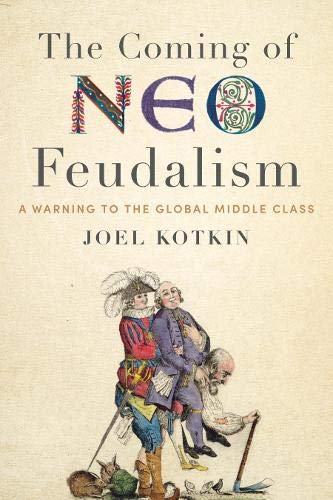
Joel Kotkin is the author of The Coming of Neo-Feudalism: A Warning to the Global Middle Class. He is the Roger Hobbs Presidential Fellow in Urban Futures at Chapman University and and directs the Center for Demographics and Policy there. He is Senior Research Fellow at the Civitas Institute at the University of Texas in Austin. Learn more at joelkotkin.com and follow him on Twitter @joelkotkin.
Jennifer Hernandez has practiced land use and environmental law for more than 30 years, and leads Holland & Knight's West Coast Land Use and Environmental Group. She is a former longtime co-chair of the firm's national Land Use and Government Team. Ms. Hernandez divides her time between the firm's San Francisco and Los Angeles offices.
Researchers
Wendell Cox is a leading proponent of adopting land use and transport policies based on their effectiveness in improving the standard of living and alleviating poverty. He is principal of Demographia (Wendell Cox Consultancy) in the St. Louis metropolitan area. He specializes in urban policy, transport and demographics and is author of Demographia World Urban Areas and co-author of Demographia International Housing Affordability Survey. He is also author of Toward More Prosperous Cities, a framing essay on urban areas, urban planning, urban transport and sustainability.
Marshall Toplansky is an award-winning Innovation Professor of Management Science at the Argyros School of Business and Economics at Chapman University. He is a widely published and award-winning marketing professional and successful entrepreneur. Marshall co-founded KPMG's data & analytics center of excellence and now teaches and consults corporations on their analytics strategies.
Erika Ozuna is a senior consultant at Chapman University’s Center for Demographics and Policy. She currently works on multifamily and senior housing analysis and market studies throughout the country. Ozuna has over ten years of experience in the commercial real estate industry, including experience in all types of senior housing appraisals. Prior to her multifamily housing experience, Erika worked for seven years in the banking and investments fields, has conducted quantitative and qualitative research and analysis for numerous projects and entities, and was a high school teacher. Erika holds a M.P.P. in international relations and economics from Pepperdine University and a B.S. in business administration from the University of Texas RGV.
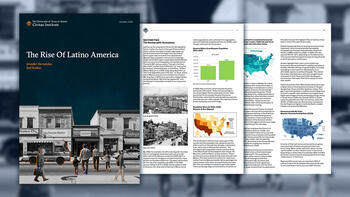
Photo: report cover and pages from the report, Civitas Institute.
 Email this Story