Discovered by chance at a photo book fair, Peter Mitchell’s photographs of Leeds capture a civic world that assumed legibility, continuity, and shared meaning - before cities became abstract, branded, and hollowed out.
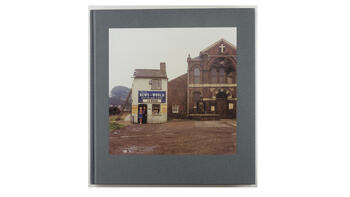
The cover of Peter Mitchell’s Strangely Familiar tells you almost everything you need to know - if you know how to look.
A tiny newsagent’s shop stands alone on muddy ground on the outskirts of Leeds. The sign reads, READ THE NEWS OF THE WORLD. BEST FOR NEWS & SPORT. The proprietors, Mr. and Mrs. Hudson, stand in the doorway, neither smiling nor performing. To the right, a Methodist church rises in brick solidity, its cross fixed firmly in place. Between them: churned earth, pause, uncertainty. Something has been removed. Something has not yet replaced it.
Nothing in the photograph is sentimental. Nothing is ironic. Nothing is explained.
The image assumes that you understand what you are seeing - or that you are capable of learning how.
That assumption is Peter Mitchell’s great gift. And Strangely Familiar is built around it.
I did not go looking for Peter Mitchell. I stumbled onto him at a photo book fair, amid tables crowded with contemporary photography that often leans hard on provocation, cleverness, or spectacle. Mitchell’s book sat quietly, modestly, almost shyly. But once opened, it refused to let go.
This is not a plea to freeze cities in amber or to romanticize decline; it is a reminder that change need not erase legibility.
What I encountered was not nostalgia, nor documentary moralizing, nor aestheticized decay. It was something rarer and more demanding: a record of ordinary civic life before it was abstracted, optimized, or erased. A world that assumed its own legibility.
Mitchell was born in Doncaster in 1943 and trained at the London College of Printing in the 1960s. He began photographing Leeds in the early 1970s and stayed with the city for decades - not as a tourist, not as a provocateur, but as a witness. His work was among the first serious uses of color in British documentary photography at a time when galleries still treated color as commercial, unserious, or disposable.
Mitchell understood something institutions did not: color is not decoration; it is evidence. The everyday world, rendered faithfully, carries meaning precisely because it is ordinary.
That conviction runs through Strangely Familiar. Shopfronts declare their purpose plainly: S. Tunick & Son, Stationers. East End Tool Stores, Est’d 1896. Robinson’s Famous Fisheries. Typography matters. Windows matter. The buildings assume permanence. They expect memory to accumulate.
People, too, stand differently in Mitchell’s photographs. They are not “subjects.” They are participants. Mrs. Collins and Mrs. Clayton stand in front of their fish shop without performance. The building’s meaning depends on their presence; their presence depends on the building. Work and person remain legible together.
Even when Mitchell photographs decline or demolition, the images do not plead or accuse. A red telephone box stands marooned amid the flattened remains of Quarry Hill Flats. The drama is not loss alone, but the disappearance of civic grammar - the cues that once told people where they were and what was expected of them.
Mitchell understands this explicitly. In his accompanying texts, he writes about walking through “new canyons of glittering emptiness,” places that promise progress while erasing meaning. Bulldozers do not merely remove buildings; they sever the chain of recognition between people and place.
Modern cities are intensely visible but rarely legible. Buildings announce brands rather than functions. Storefronts rotate. Churches become condos. Public space is curated, programmed, optimized. Where Mitchell shows shops that announce their purpose, today we more often encounter blank facades wrapped in branding that tells us nothing about who is inside or why they are there.
What Mitchell photographs aligns, quietly but unmistakably, with a tradition of urban thought that took legibility and lived experience seriously. Cities work when streets communicate purpose and responsibility - when people can read who belongs where and why. A humane city is one whose paths, edges, landmarks, and districts form a mental map that ordinary citizens can hold in their heads. The danger of modern planning is not change itself but abstraction: efficiency replacing meaning, scale replacing intimacy, management replacing recognition. Mitchell’s Leeds is a visual record of what that earlier wisdom described in words—a city whose everyday architecture, signage, and social rituals made sense without instruction. His photographs do not illustrate theory; they confirm it.
In an era when cities increasingly treat space as content, experience, or investment rather than as a shared moral environment, Mitchell’s photographs remind us what is lost when places stop expecting to be understood.
One caption near the end of the book captures his sensibility perfectly. A postcard shows a ghost train stranded on Woodhouse Moor while its generator is repaired. The ride of death must “take a nap until the power gets fixed.” Mitchell borrows a lyric from a pop song: “I’ve been riding on the ghost train… I don’t know where I’m going but I’ll always tell you where I am.” There is humor here, but also steadiness. Life pauses. It resumes. Place can still be named.
This is what gives Strangely Familiar its quiet authority. Mitchell is not photographing an aesthetic. He is documenting a structure of civic attentiveness - a way of seeing that assumed continuity, coherence, and mutual recognition in everyday life.
The cover image makes this plain. The small newsagent and the Methodist church do not compete. Neither overwhelms the other. Both simply are. Different institutions, different purposes, sharing the same ground. Today, such coexistence feels almost implausible.
Mitchell’s Leeds operates on a different principle. Seeing is acknowledgment. Architecture speaks before it is interpreted. Ordinary places expect to be known. People stand in front of their work not to advertise themselves but to acknowledge responsibility.
This is not nostalgia. It is orientation.
Mitchell does not claim the past was perfect. He insists it was coherent. Places knew what they were for. Signs told the truth. Belonging was built into the visual order of everyday life - not curated, not branded, not performed.
That is why Strangely Familiar feels so bracing when encountered unexpectedly. It does not shout. It does not instruct. It simply says: This was here. This mattered. You can see it if you look.
The renewed attention to Mitchell’s work - through Strangely Familiar and the careful reproduction of his prints - is not a backward-looking revival. It is a reminder that cities once trusted ordinary people to read their surroundings, to understand where they were, and to locate themselves within a shared landscape of meaning. When places speak clearly, citizens do not need constant explanation; they learn the city by moving through it.
I closed the book with gratitude and unease. Gratitude for encountering a photographer who saw so clearly. Unease because his clarity throws our present condition into relief.
We live among images that demand attention but offer little recognition. Mitchell shows us a world that did the opposite - one in which streets, buildings, and faces formed a comprehensible whole, and where seeing was itself a civic act.
Strangely familiar indeed - not because it flatters memory, but because it reminds us that cities once made sense. And once you look with Peter Mitchell’s eyes, the ordinary world begins to speak again - and you are no longer free to pretend that its silence is inevitable.
______________
Samuel J. Abrams is a professor of politics at Sarah Lawrence College, a senior fellow at the American Enterprise Institute, and a scholar with the Sutherland Institute.
 Email this Story