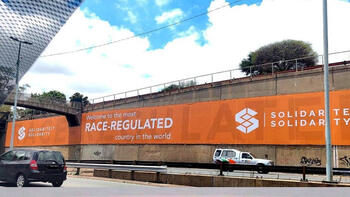
As South Africa hosts the G20 Summit in Johannesburg on 22-23 November 2025, the event has been overshadowed by two high-profile disputes over race policy.
First, U.S. President Donald Trump announced a full boycott by U.S. officials, declaring on Truth Social that holding the G20 in South Africa was “a total disgrace” because of alleged government-sponsored discrimination against Afrikaners, including claims of killings and land confiscations.
Second, and directly tied to the same debate, the Afrikaner trade union Solidarity in November 2025 erected more than 30 digital billboards and banners along key G20 routes proclaiming South Africa “the most race-regulated country in the world”.
Johannesburg authorities removed most of them within hours, citing lack of permits. Solidarity immediately obtained an urgent interim interdict from the High Court, replaced the boards, and—in protest—escalated by erecting over 50 additional banners across Gauteng highways and airport approaches. Gauteng Premier Panyaza Lesufi publicly welcomed the initial removals as a defeat of “racism” and labelled Solidarity members “racists” on X, while the union accused him of censorship and incitement. Meanwhile, the South African Presidency dismissed the campaign as the work of a “tiny right-wing minority” intent on embarrassing the nation.
With regards to race laws, South Africa currently has 142 pieces of national legislation that explicitly or implicitly make race a legal criterion for rights, benefits, obligations or penalties. This is more than existed at the height of apartheid (123 in 1980), according to the Institute of Race Relations’ continuously updated Index of Race Law, last revised on 11 June 2025. Of the 142, 116 have been enacted since 1994.
The list includes major framework laws such as the Broad-Based Black Economic Empowerment Act (2003), the Employment Equity Act (1998), the Preferential Procurement Policy Framework Act (2000) and recent amendments to sector charters (mining, water services, electricity, etc.) that impose minimum Black ownership or management percentages as licensing conditions.
A significant portion of the 142 statutes are, however, outdated or partially obsolete. At least 26 pre-1994 laws still on the statute book contain racial references that have never been repealed or amended (for example, old group-areas extensions, certain pension-fund racial clauses, and remnants of the Population Registration Act repeal process that left stray provisions intact). Critics of the IRR index therefore argue that the “142” figure is inflated because it mixes active transformative legislation with dormant apartheid-era relics.
Read the rest of this piece at Hügo's Newsletter.
Hügo Krüger is a South African born Structural/Nuclear Engineer, writer and YouTube podcaster, commentating on topics relating to Energy and Geopolitical Matters, Hügo is married to an Iranian born Mathematician and Artist; the couple resides in Paris.
Photo: courtesy Hügo's Newsletter.
 Email this Story