You know, prior to the Covid pandemic, there was a lot more discussion in the urbanist sphere about economic inequality and a lack of economic mobility in cities, and their influence on the rising unaffordability of the American housing market. After the pandemic, that kind of discussion dissipated and morphed into something much broader – affordability, and later, abundance – that didn’t carry the same race and class associations typically given to inequality and mobility concerns.
That’s fine for people seeking to broaden support for policy action on affordability. However, it doesn’t touch on the entirety of the affordability problem.
Last week, Crains Chicago Business reporter Dennis Rodkin wrote about metro Chicago’s two-tiered real estate market – one that’s booming for the wealthiest Chicagoans, and one that’s flat for virtually everyone else. Here’s a quote from the paywalled article:
“In the uppermost echelon of home prices, sales took only until early November to pass the record number of homes sold in a full year. And one sale among them, a Winnetka estate that sold for $31.25 million, was the highest-priced sale of an existing home ever in the Chicago metro area (other homes have been built new for more). Meanwhile, in the market for homes at all prices, the number of sales is running only slightly higher than even with 2024, a year that ended with the fewest homes sold since 2011.”
In Rodkin’s interview with Jena Radnay, an agent with @properties Christie’s International Real Estate on Chicago’s North Shore, Radnay said, “(North Shore buyers may be) doing well with their business, sold their companies and cashed out, gotten massive promotions,” invested well or inherited wealth, she says, “and they’re happy to pay what it takes for real estate up here where they know it’s a good investment.”
Rodkin also spoke with Anthony Simpkins, president and CEO of Neighborhood Housing Services. The Chicago nonprofit focuses on financing homeownership in low- to moderate-income neighborhoods, but Simpkins’ perspective on the housing market takes in the middle class as well. Simpkins’ take? “It’s no secret that housing has gotten too expensive for almost everyone.”
Rodkin’s basis for Chicago’s dual housing market comes from his comparison of home price growth with median income growth in the Chicago metro area, between 2014 and 2024. Rodkin’s analysis compared home price growth and median income growth over two periods, 2014-19 and 2019-24. The map below shows areas where home price growth exceeds median income growth (shades of red), and areas where home price growth is surpassed by median income growth (shades of blue):
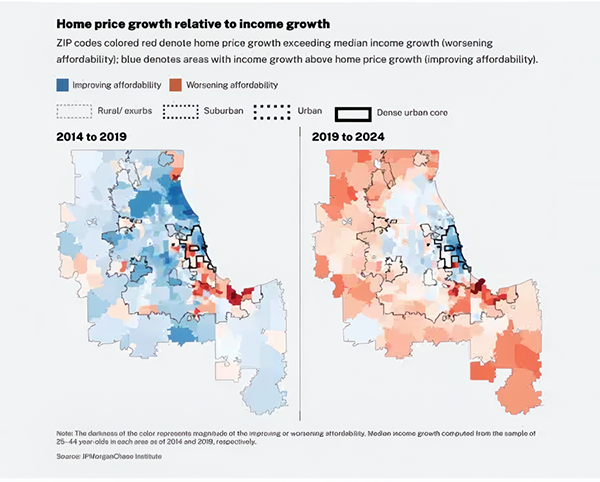
Rodkin sums up his position in this quote below:
For the past year and a half, Chicago-area home prices have been rising faster than the national average and faster than in nearly every major US city, accelerating the local affordability crunch right alongside interest rates that have remained relatively high.
Rising prices and mortgage interest rates that are twice what they were a few years ago take a one-two punch at affordability, and uncertainty about future financial well-being amid mass layoffs and the creeping hegemony of AI makes the hit feel even harder. “As the cost of housing has gone up dramatically,” Simpkins says, “people are feeling more challenged with being able to keep good-paying employment.”
Honestly, I think Rodkin is making a valid point with his framing of the Chicago housing market. From a pure residential real estate sense, there appears to be a clear worsening of housing affordability, with wealthy buyers getting what they want and others struggling.
Read the rest of this piece at The Corner Side Yard.
Pete Saunders is a writer and researcher whose work focuses on urbanism and public policy. Pete has been the editor/publisher of the Corner Side Yard, an urbanist blog, since 2012. Pete is also an urban affairs contributor to Forbes Magazine's online platform. Pete's writings have been published widely in traditional and internet media outlets, including the feature article in the December 2018 issue of Planning Magazine. Pete has more than twenty years' experience in planning, economic development, and community development, with stops in the public, private and non-profit sectors. He lives in Chicago.
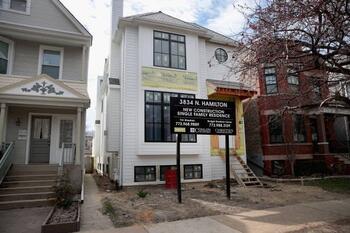
Photo: Chicago housing for sale, courtesy The Corner Side Yard.
| Attachment | Size |
|---|---|
| 2019-2024-chicago-housing-stats.png | 381.4 KB |
 Email this Story